Fo Guang Shan and the Selling of a Holy Place (Day 10)
Date:
Last modified: August 14, 2026 (13:37 UTC)
How do holy sites maintain business? I discuss this question for this tenth day of Blaugust, as I recall my trip to 佛光山寺/Fo Guang Shan Monastery in 高雄/Kaoshiung.
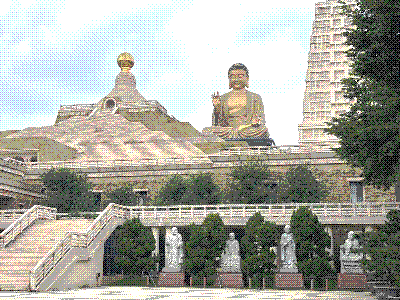
Anyone who has looked into places to visit in 台灣/Taiwan outside of 台北/Taipei is sure to have seen the 佛光山寺/Fo Guang Shan Monastery in 高雄/Kaohsiung recommended, all for good reason. It’s one of the largest monasteries in Taiwan with name brand recognizablity across the island and increasingly so in Mainland China. Since my research is in contemporary Buddhist holy sites, obviously I had to check it out. Admittedly I did not go to the actual monastery grounds I hadn’t done much research before going and I wasn’t sure or not if it was open to the public; it very much is., but I went to the adjacent Buddha Museum. And here is where I found something interesting.
Before I begin discussing the Museum, I first want to introduce a monastery in my college town: the Tibetan Mongolian Buddhist Cultural Center and Kumbum Chamtse Ling Monastery (or TMBCC for short) in Bloomington, Indiana. The elder brother of the 14th Dalai Lama For those unaware, that’s the current Dalai Lama., the 6th Taktser Rinpoche Thubten Jigme Norbu, was a professor at Indiana University in Tibetan Studies. Bloomington has since then been the home of a sizable Tibetan diaspora community, and the monastery grounds are evident of that.
If one were to think of a “Buddhist monastery”, the TMBCC would be pretty close to what one would imagine. Its tranquil, with some small unassuming, but pretty buildings. There’s statues of the Buddha and other prominent Buddhist figures and areas for meditation. Tibetan prayer flags are abound. A visitor would leave feeling like they got the “Buddhist experience.”
Whether we consciously acknowledge it or not, every visit to a holy site comes with it a set of expectations, depending on what our view of the religion is. Buddhist monasteries are calm and quiet, perhaps accompanied by the sound of chanting monks and gongs. Catholic cathedrals are grand and filled with detail, heavy with the smell of incense and loud with the sound of classical music. Islamic mosques are adorned with sweeping calligraphy and the noise of the adhan. These are some stereotypical expectations that at least I have going into a holy place; perhaps for you they are different, but we all at least have some.
With all that said, I did have a bit of a shock when I walked into the Front Hall and the first thing that I am greeted with is… a Starbucks. Just, kinda there. Next to it were a series of vegetarian restaurants, some standard drink shops that wouldn’t be out of place in a night market, and some assorted shops selling various Buddhist memorabilia. To be honest, I was a little shocked. I was expecting the stores selling Buddhist goods, it seemed pretty typical from most religious-sites-that-are-also-tourist-attractions that I’ve been to, but the corporate restaurants were a bit more shocking.
Obviously 佛光山/Fo Guang Shan does have some things that differs it from other Buddhist temples. First, it’s a sprawling international organization, instead of local monastic orders. Second, it’s promotion of Humanistic Buddhism A flavor of Buddhism that began with the Buddhist modernizer 太虛/Taixu (1890-1947), which Wikipedia describes as “a modern philosophy practiced by Buddhist groups originating from Chinese Buddhism which places an emphasis on integrating Buddhist practices into everyday life and shifting the focus of ritual from the dead to the living, while honoring ancestors.” It’s extremely popular within 台灣/Taiwan. means that they have a larger mission focused around charity and education. This focus results in having larger expenditures, requiring a larger source of income. I think it’s also part of a larger feature of holy sites, which is the idea that they need to sell an experience, and one part of this experience is comfort.
It’s pretty easy to understand. It’s not exactly the most attractive draw to have people travel around an hour to get to the Monastery, then have the only food and drink amenities be basic monastic food. It’ll hurt people’s opinions of the place, since when we go to holy spaces, we aren’t really looking for the platonic ideal of the religious life. We want to be catered to, to feel like we are in a special place. We don’t actually want to go to a monastery that seems unfocused on whether or not we are there, since it makes it less likely for us to feel like we had an “experience” and more that we just saw some interesting buildings. I think this is different if the journey of the pilgrimage is undertaken and the pilgrim is fairly devout, as you would want that rawness of the religious experience. I should read up on how buildings in Jerusalem dealt with pilgrims and see if travelogues of old complained about lack of nice amenities lmao.
Holy sites also just need a way to make money. Especially in modern secular society, if there isn’t the aid of a historical preservation organization (either private or public), then the site will need some way to make money in order to pay for repairs, staff, and feeding monastics. This has always been a problem for holy sites, and why imperial patronage in China was so coveted. You were doing pretty good if the government provided for all your needs! Since 佛光山寺/Fo Guang Shan Monastery is very modern, with construction beginning in 1967 and the Buddha statue being built in 1975. Fun fact, the Monastery itself was closed to the public from 1997 to 2000 as they wanted to give the monastics a cloistered environment, but the President of Taiwan and officials from 高雄/Kaohsiung requested it to be re-opened. My point still stands since the main business of the Monastery is in the Museum section, which remained open during the closure. There is no external aid given, and so the Monastery needs to make money somehow while also catering to visitors, many of whom (at least from my experience) are either foreigners or not from the area.
This has made me more motivated to begin doing my research into pilgrimage and holy sites, since I think there is more business than people would expect. Regardless of all this, I’d still recommend actually visiting. They say they have a tooth relic of the Buddha Gautama… but I doubt its authenticity. A ton of famous monasteries say they have a tooth relic.